


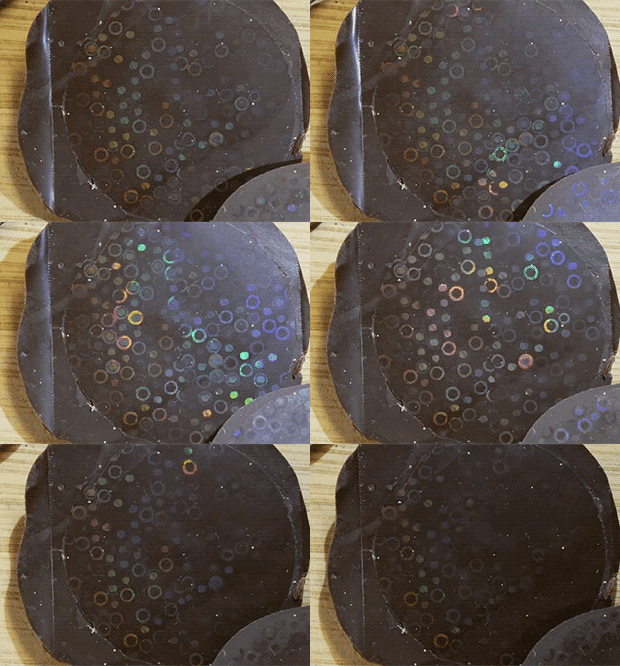
An engineer from the USA created color three-dimensional images on the surface of the chocolate. He used holographic stickers, which he processed and turned into a form for filling. The author spoke about the methods and results achieved on his YouTube channel.
The method of recording a three-dimensional image of an object on an optical surface — holography — was invented by the Hungarian scientist Denesh Gabor in the middle of the last century (and later received the Nobel Prize in Physics for this). The physical principle of this technology is the addition of two waves of light from one source, the first of which (reference) immediately hits the recording material, and the second (object) is previously reflected from the recorded subject. With prolonged exposure, the waves leave a trace on the surface that repeats the dark and light bands of the interference pattern. If you then again illuminate the material with a reference wave, this trace will fulfill the role of a diffraction grating and turn the wave into a near-object wave. The observer will see a three-dimensional picture — it will reproduce with a slight distortion the appearance of the original object.
Engineer Ben Krasnow from Northern California decided to follow the example of the manufacturer of diffraction chocolate, but this time to give the product full holographic properties. For this, the experimenter used holographic stickers, which he bought online specifically for the experience. For convenience, he glued the material with a polycarbonate plate and dissolved the foil and paper coating in sodium hydroxide. The plastic base, the pattern of which stored information about the image, was not affected. The subject turned into a finished form — the author poured heated chocolate into it, which solidified at room temperature and turned into a hologram carrier.
This method allowed the experimenter to create only small holograms up to 20 millimeters in size — they could not form larger images. The engineer suggested that at the moment of cooling the product is destroyed — under the influence of temperature, chocolate and plastic taper and expand differently, and with sufficiently large sizes this difference interferes with the experiment. To avoid the problem, the author made a mold of food-grade silicone — with more flexible material he managed to get large-sized holograms. Krasnov notes that the resulting holographic chocolate is still edible and contains no additives.
Kamkar already managed to evaluate the work and share his experience in the comments to the video.