


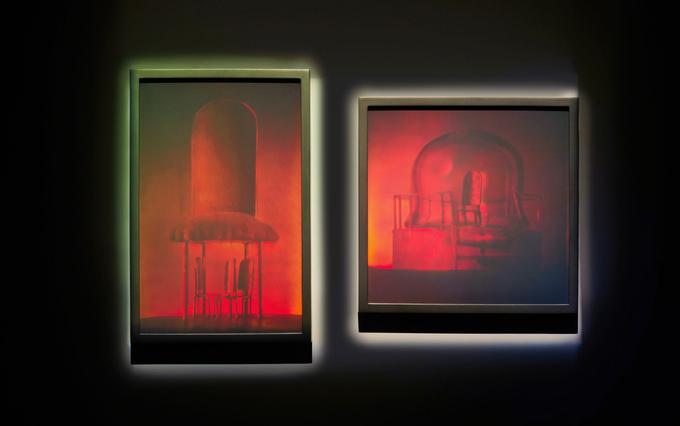
Russian researchers analyzed the possibility of holographic recording in the absence of mutual coherence of wave beams, or pulses. It turned out that the coherence of wave beams is an optional condition for such a recording. The new approach will allow obtaining information with extremely accurate time correspondence in interferometric and holographic experiments.
Holography is a photographing technology that allows you to get three-dimensional images of objects. Such an effect is possible due to the existence of diffraction and interference of light. In a conventional hologram, a laser beam of light is expanded and divided into two parts. One of them, the reference beam, is reflected from the mirror and falls onto the photographic plate, and the other, the object beam, is reflected from the object. In this case, both beams must be coherent, that is, the waves must be consistent in time and space.
During holographic recording, the reference and subject beams are added up on a photographic plate, as a result of which an interference pattern is created. When the waves are superimposed on each other, they either reinforce each other, creating a wave of higher intensity, or cancel each other out, reducing the overall intensity. Moreover, if the object moves, then short pulses of light are used to operate the device. This is due to the fact that the movement of the object blurs the interference pattern, which leads to the disappearance of the beam — a copy of the object. However, the shorter the pulse, the smaller the area of overlap and interference of the rays. Therefore, it is promising to use very short pulses for holographic recording when recording very fast processes. However, it is almost impossible to create an interference pattern with their help.
Today, researchers have already learned how to create attosecond pulses. Physicists are already on the way to obtaining unipolar and subcycle pulses, which contain only half the period of oscillations of the light wave. Supported by a grant from the Presidential Program for Research Projects of the Russian Science Foundation, researchers from St. Petersburg State University and ITMO University, together with colleagues from Germany, proposed using precisely such ultrashort pulses to resolve the contradiction that arises in conventional interferometry and holography.
The contradiction is that for great accuracy in displaying an object in holography, you need to use monochromatic light, and to create a hologram that can capture a rapidly changing object, you need very short pulses.
In a new work, scientists showed that the pulse duration does not matter, since the light beams in the recording medium do not intersect at the same moment. High monochromaticity, which is necessary for recording a hologram, is achieved by transferring it to a long-lived medium polarization wave. And then a very short impulse will interact with this wave. Moreover, the shorter such an impulse, the more accurate its effect.